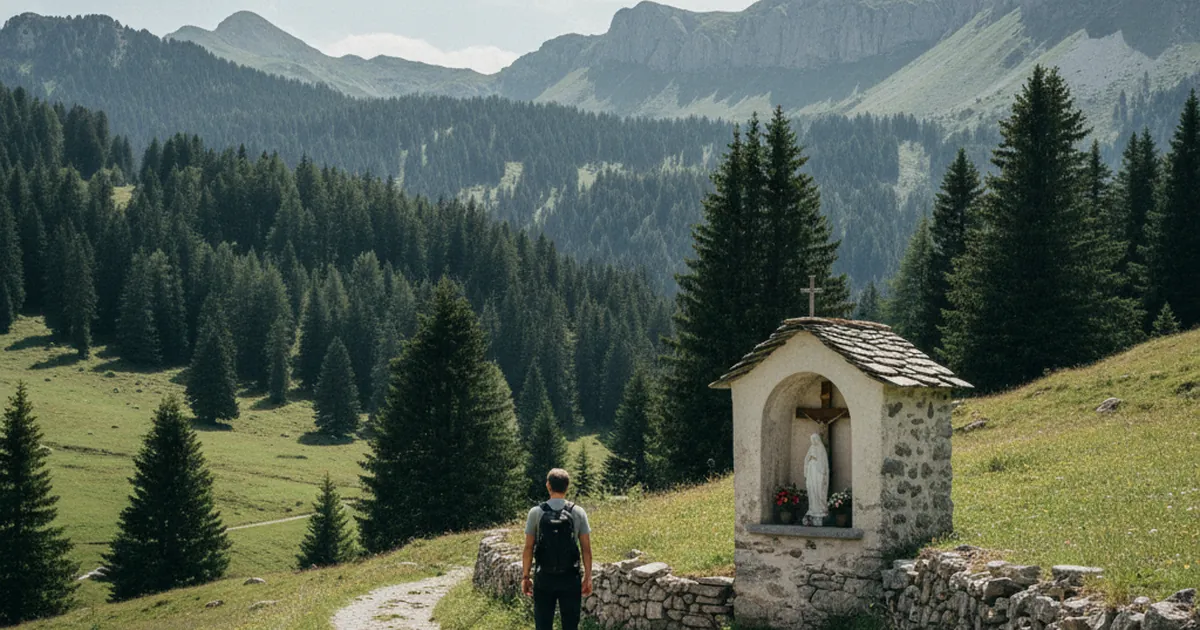
On the old trails of Haute-Savoie, between the beech forests and the hay meadows, you sometimes come across a small stone niche by the side of the path. A roadside shrine, called an oratoire in French. Not always marked on the map, sometimes overgrown with ivy or decorated with dried flowers, it is one of the oldest human traces left on these routes. For those who know how to look, these modest monuments are open-air archives.
A monument of popular devotion
A roadside shrine is a masonry niche, sometimes carved into a rock or simply set into a low wall, that houses a small religious figure. A Virgin Mary, a Christ, a patron saint: the figure varies with local devotion. This is not a chapel. There is no nave, no altar in the liturgical sense, no space for a congregation. It is a place for individual prayer, erected by a family, a craftsman or a village community, without necessarily any official consecration.
The size varies considerably. Some shrines fit into the hollow of a boundary wall and are barely larger than a bread box. Others are more carefully finished, with dressed stonework, a sculpted cornice and a carved inscription. Between these two extremes, there is every possible variation in craftsmanship and period.
Why did people put these stones here?
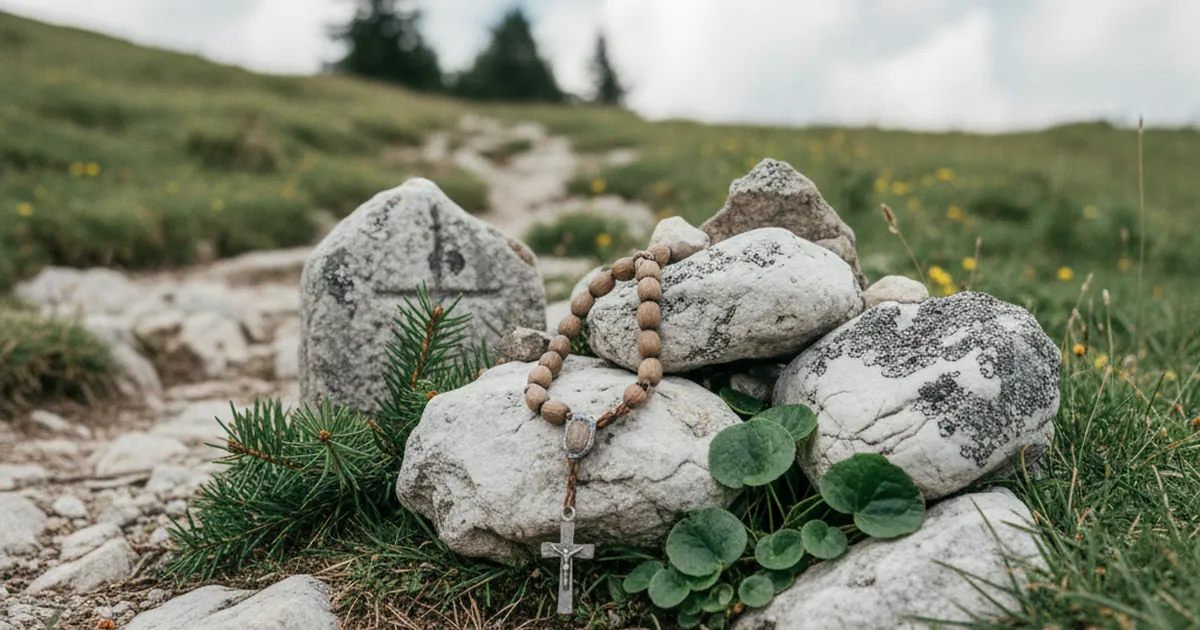
The reasons for building a shrine are many and often intertwined. Some mark a vow fulfilled: a child cured of illness, a herd found after going missing, a near-miss on a tricky passage. Others are memorials: a shepherd swept away by an avalanche, a porter who died on a high route, a villager lost suddenly. Others still serve as territorial markers: the boundary between two communes, the entrance to a summer pasture, the junction of two transhumance routes.
In the Savoyard valleys, these small monuments punctuate routes that predate modern roads by centuries. Bridges have been rebuilt, hamlets have sometimes been abandoned, but the shrines often survive. They are the fixed points of a territory in constant transformation.
Reading a shrine, reading a landscape
A shrine tells you something about its territory. The date carved into the stone, if still legible, places the monument in the local history of devotion. The saint depicted hints at the concerns of the place: Saint Bernard of Menthon for passes and travellers in danger, Saint Roch for protection against epidemics, the Virgin Mary for a more general intercession.
The quality of the stonework reflects the resources of whoever commissioned it. A niche assembled by hand from stones picked up in a nearby field has a different story to tell than a dressed-stone shrine with a carved inscription. Both deserve the same attention.
On the old routes of the Pays du Mont-Blanc and across the highlands above Annecy and the Bauges, these monuments line itineraries that have been used for centuries by shepherds, merchants and travellers on foot. Today's hiker passes them without always stopping.
Spotting them on the trail
A few practical pointers for not walking past them:
- Look at crossroads. Old paths often met at points marked by a shrine, which served as a shared waymarker.
- Check the old walls. Shrines are frequently set into the boundary walls of meadows or built against a barn or farm building.
- Watch for isolated trees. A lime tree or walnut planted alone at the edge of a path sometimes signals a shrine at its foot.
- Notice unusual piles of stones. An abandoned shrine may be reduced to a recognisable niche among fallen rubble.
IGN maps at 1:25,000 scale mark some shrines with a cross symbol and the word "oratoire". Many do not appear on maps at all. A slow walk with your eyes on the sides of the path remains the best approach.
Trails where you are likely to find them
Some itineraries in Haute-Savoie cross old territory where these monuments are relatively common. The Tour d'Agy, starting from Saint-Sigismond in the Arve valley, passes through several old hamlets with characteristic stone walls where a few shrines still stand.
Further north in the Faucigny area, the climb to Loëx from Taninges follows old paths up towards the summer pastures, through farming country where the tradition of wayside shrines was well established. Neither route is signposted for its shrines: it is up to the walker to discover them at their own pace.
The trails across Haute-Savoie are full of these small monuments if you take the time to look for them. The challenge is not the walking. It is learning to see what lines the path differently.
Conclusion
Roadside shrines are not among the headline attractions of the Savoyard mountains. They are not the kind of thing you drive hours to see. But if you are interested in what the mountains hold that is most human, these small stone niches are a good place to start. They force you to look up from your map and see the paths you walk in a different light. Once you have learned to notice them, you start to see that someone walked these same paths long before you, and thought it worth leaving a mark.