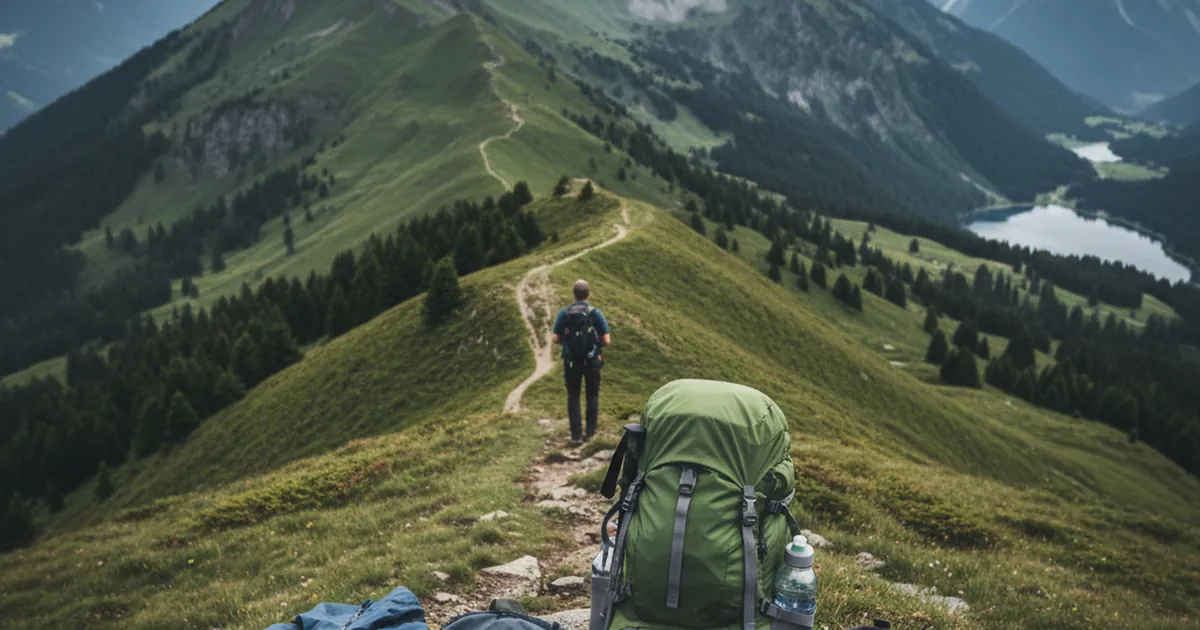
A hiking daypack is not a grocery bag. Too light, you run out of water at the pass by noon. Too heavy, you finish the day with burning shoulders. Between those two, there's a fairly precise list of things to carry when hiking in Haute-Savoie, whether you head up to Pic de Marcelly with the family or link a Chablais ridge.
Here's how I build my daypack, in the order I fill it.
Water and food
Water goes in first, always. Plan for at least 1.5 litres for a half day, 2 to 2.5 litres for a full day in heat or at altitude. When in doubt, take a bit more. Water is never too much.
For food, aim for two reference points:
- A solid lunch: sandwich, wrap, savoury tart. Nothing that runs, nothing that melts.
- Quick snacks you can open one-handed: dried fruit, cereal bars, chocolate squares. Top up every 40 to 50 minutes without digging through your pack.
Rigid bottle or soft bladder, your call. Always keep a small reserve for the descent in case it takes longer than planned.
Clothing and protection
Even in glorious weather, the mountains demand three layers in stock:
- A light warm layer: thin fleece or packable down. It's for the summit, the lunch stop, or when the wind picks up.
- A waterproof shell: even if the forecast promises sunshine, a 20-minute shower can arrive unannounced at altitude. A Gore-Tex or similar is essential.
- A spare t-shirt: after the climb, you're often soaked. Changing at the summit before heading down keeps a cold off.
Add a beanie and thin gloves whenever you go above 1,800 metres, or outside the June to August window. Even in July, a ridge can freeze at dawn.
For the sun, pack sunscreen (SPF 50 above 2,000 metres), sunglasses, and a head cover. UV at altitude hits much harder than in the lowlands.
Navigation and safety
You can pack light on this front, but not to zero. My minimum:
- An IGN TOP25 map of the area, even with a GPS. The GPS dies, the map doesn't.
- A charged phone with an offline navigation app (IGN Rando, Visorando, Gaia). Airplane mode most of the time, online briefly to check weather when signal is available.
- A light headlamp, even for a day outing. Night falls fast when things go sideways.
- A whistle: 10 grams that can get you rescued if you're hurt out of sight.
- A space blanket: essential, even for a 4-hour outing.
Add a minimalist first-aid kit: plasters, dressings, elastic bandage, disinfectant, painkiller. All of it fits in a 15 cm pouch.
The small essentials often forgotten
The list that makes the difference between a smooth walk and a friction-filled one:
- A small plastic bag for your rubbish (carry out everything, nothing goes in the wild).
- Toilet paper in a zip-lock. Yes.
- A tick removal tool. Tick season starts in April in the valley.
- A notepad and pencil (to jot down a fact, a contact, or the summit log if you meet a cross).
- A power bank for long days.
Adapting to season and terrain
April's pack isn't August's. In early season (April, May, early June), add microspikes for late snowfields that hang on north-facing slopes. In summer, go lighter on warm layers but take more water. In autumn, anticipate the 6:30 pm nightfall in October and pack a headlamp with fresh batteries.
Terrain matters too. On a ridge in the Chablais or in the Fer-à-Cheval cirque in the Giffre Valley, trekking poles are recommended. On a gentle plateau like Sommand or Praz-de-Lys, you can skip them.
The summary checklist
For a classic day in Haute-Savoie, my pack contains:
- 1.5 to 2.5 litres of water
- Lunch + 3 to 4 snacks
- Fleece, shell, spare t-shirt
- Beanie, gloves, sunscreen, sunglasses, cap or hat
- IGN map + charged phone + headlamp
- Whistle + space blanket + first-aid kit
- Rubbish bag, toilet paper, tick tool, notepad
All of it in a 25 to 30 litre pack. Bigger and you've overpacked. Smaller and you'll struggle to stash the fleece or shell at the summit. Have a good walk.